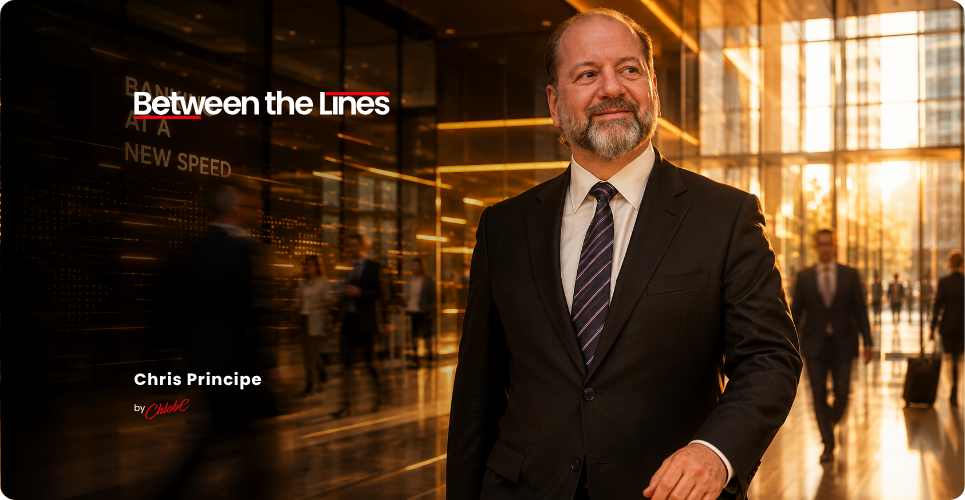
Banking at a New Speed

Chris Principe and Belkis López discussing banking technology, trade finance and the future of financial innovation
A conversation with Chris Principe on what AI, stablecoins, quantum and legacy technology mean for the future of banking

“What was done a decade ago in a year is now done in a month or less. This time frame will continue to collapse.”

From global trade and entrepreneurship to financial journalism and fintech publishing

You've spent over 35 years moving between hands-on global trade (Medi-Globe), banking software, and now journalism as Publisher of Financial IT. What convinced you, after building and selling your own company, to spend the rest of your career telling other people's stories in fintech instead of building another one yourself?

Hi Belkis, thank you so much for the opportunity to do this interview, it is much appreciated. It is interesting when you put it this way as I look at Financial IT as both.

I have always been very interested in how things are made, done, processed and presented, that telling other people’s stories was a natural way to satisfy my own curiosity. I like to think that if something is curios for me, that it would be to others.

From global trade to financial journalism and fintech publishing

The other side is that with Financial IT, I am building another one myself. There is a lot of satisfaction to see the growth since starting in 2012.

Today are especially interesting times in media as there is an incredible amount of content being produced. The value today is the delivery platforms for this content.

What started for me as a way to tell the stories that interest me and to write my own views without interference from company censorship has now become a meaningful voice in the financial community.


The evolution of banking technology from legacy systems to AI, stablecoins and quantum computing

Financial IT has covered nearly every major shift in banking technology — from core banking to blockchain to embedded finance. Looking back, which trend did the industry get completely wrong at first, and which one is still underestimated today?

Great question as it’s fun to think through all of the trends over the years. First, I will say that the historic trend in the financial community is to never be first with new trends. Better to be second after others have done it first. This has set the banks on their heels for decades and has not given them the chance to get a trend right or wrong.

That has changed. Today things are moving to fast. What was done a decade ago in a year is now done in a month or less. This time frame will continue to collapse.

Banks accelerating adoption of AI, stablecoins and quantum computing

Over the last year or two I have seen a definite change in bank approaches. They were very quick to get in front of the movement of stablecoins as well as with A.I.

I know of a number of big banks that are leasing time on Quantum computers so that their teams can learn and develop with the advantages that Quantum will bring. This would have never happened in the past. For me this is a mentality change that is so refreshing.

You asked about banking technology that has, let’s same not gone as planned. For me it is core banking. Most banks, especially in the west, still run on 80’s and 90’s tech, typically COBOL. The investment and maintenance are a huge percentage of a banks IT budget.

Legacy COBOL systems running on mainframes have operated continuously for decades without crashing, providing mission-critical dependability for banks. Core banking systems running on COBOL has historically been a strong combination.

The issue is adding new functionality as banking evolves is difficult. Today with flexibility offered from best-in-class product specific apps and the ease in integration provides quicker, better solutions to the market. Legacy technology with its high invested costs makes change difficult.

This gives new advantages to regions, such as Latin America, Africa and parts of Asia where the investment into legacy systems was not made. Financial institutions in these areas are leap frogging the west and instituting the latest and greatest technology with ease.

Legacy core banking systems evolving toward flexible modern banking architecture

Core banking has gone from being monolithic solutions to now integrating the best vendor solution for each phase of banking. This is quite a turn around from the original benefits associated with a single core banking system.

Global trade finance and transaction banking evolving through faster, more connected financial infrastructure

Having watched the industry from the publisher's chair for over a decade now, where do you see transaction banking and trade finance heading in the next five years — and is the industry actually prepared for it, or moving slower than the headlines suggest?

My view of the industry is constantly being reshaped by technology and world events. Particularly trade finance which is the financial life blood of global trade. We all have seen the world reducing in size and growing many times more accessible. The combination of speed and reach has been amazing. This has increased the importance of trade finance.

In transaction banking it all starts with a trade transaction. A single trade transaction can provide multiple payments, FX needs, documentation, insurance, inspection, shipping mode’s, cash management, etc. Trade is the engine for transaction banking.

Stablecoins, AI and quantum computing transforming trade finance and transaction banking

There are three new pieces into this puzzle, which are; Stablecoins, A.I. and Quantum messaging/computing. Anytime, anywhere, inexpensive and immediate payments are provided by Stablecoins.

The potential of A.I. to speed up many of the labor and document intensive tasks in trade finance is awesome. Maybe for me the future of Quantum is more exciting. The incredible potential for simultaneously processing of data and messages will be impactful.

With data being more valuable than gold in the vault and banks with astonishing amounts of data, the efficiency gains will be game changing. Add into that markedly improved security.

AI transforming document-intensive trade finance operations

AI, stablecoins, and real-time payments are dominating every conversation right now. Which of these do you think will actually reshape trade finance in a meaningful way, and which one is more hype than substance?

Yes, Belkis, quite right these are the key buzz words today. For trade finance, it has to be A.I.

Historically, trade finance has been a comparatively slower banking process than everything else in banking. It takes specific training and knowledge. The processing of a trade transaction, particularly of a Letter of Credit, has well thought out rules and processes which make these human intensive activities.

A.I. fits with this so well as the access to information is near immediate, the learning capability far faster and the ability to be predictive unmatched today by people.

A.I. assisted trade will reduce time, costs, errors and find potential issues before they happen. This will have a big impact on the improvement of global trade and the global economy.

AI accelerating document processing and risk detection in trade finance
Travel, curiosity and a lifetime of learning across cultures

We've known each other for years, through FIBA circles and beyond — what's a side of you that people in the industry rarely get to see, something outside of banking and publishing that actually drives you?

Global travel and cultural discovery as a source of lifelong learning

Whew, that is a toughie. What has excited me every day to jump out of bed is being inquisitive, everything is interesting to me. I want to know how this happens, how that works, what is the history behind everything.

I have been very lucky with my life in international banking. It has taken me to 128 countries over the years.

Travel is the best education. Different people, different cultures, different histories, different sites, yes, I will never get enough!

Looking back on decades of entrepreneurship, experience and lessons learned

If you could go back and give one piece of advice to the Chris who founded Medi-Globe in 1986, knowing everything you know now about global trade, technology, and reinvention — what would it be?

That is a double edge sword. What I mean by that is the ton of advice I can now give the younger me would go to waste.

When you are young, you know it all and some older person telling you this or that has little impact on your actions, unfortunately. The younger me would listen, but then go ahead and do what I thought then was best.

I will say that I have learned more from my mistakes than when things have gone well.